Geomechanics and Geomechanical Risk Assessment
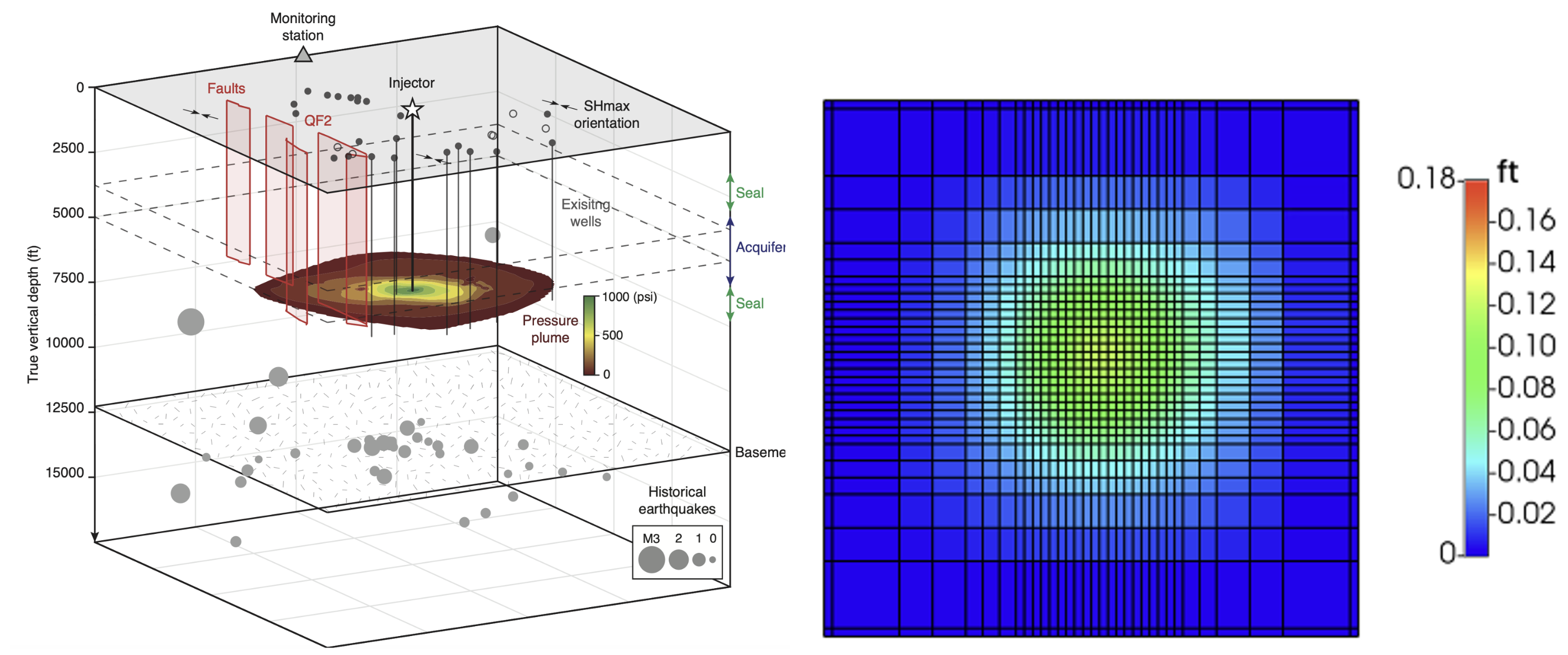
Left: Example for geomechanical assessment including location of faults, prior earthquakes, stress orientation and the pressure plume from carbon dioxide injection. Right: Predicted maximum land surface deformation (ft) accompanying injection.
The development of subsurface energy resources and storage systems inevitably alters the stress state of the Earth. Fluid injection, production, pressure depletion, thermal cycling, and chemical reactions induce mechanical deformation that influences reservoir performance, infrastructure integrity, and environmental risk. Our research seeks to understand, predict, and manage these geomechanical responses across a wide range of subsurface energy applications.
We advance the science and engineering of geomechanics, with research spanning reservoir compaction, fault stability, fracture behavior, wellbore integrity, and coupled hydro-mechanical processes. A defining principle of our work is that geomechanical behavior cannot be understood in isolation. Geomechanical risk is not solely a function of stress and rock strength; it emerges from the coupled interaction of flow, transport, chemistry, and deformation across scales. Understanding these interactions is essential for predicting the performance, safety, and long-term evolution of subsurface systems.
Our research integrates laboratory experimentation, field observations, geomechanical modeling, and reservoir simulation to investigate how pressure, temperature, fluid flow, and chemical alteration influence deformation and failure in geological formations. By linking pore-scale processes to field-scale behavior, we develop predictive frameworks that quantify how subsurface operations modify stresses, alter material properties, and influence system performance over time.
A central focus of our work is geomechanical risk assessment for subsurface energy technologies. Carbon dioxide storage, underground hydrogen storage, geothermal energy development, wastewater disposal, and hydrocarbon recovery all involve changes in pressure and stress that may affect containment, infrastructure integrity, or seismic response. We develop quantitative methods to evaluate risks associated with fault reactivation, induced seismicity, caprock deformation, fracture propagation, subsidence, and wellbore failure. These analyses provide the scientific basis for defining operational limits, evaluating uncertainty, and designing effective mitigation strategies.
Our work places particular emphasis on emerging energy technologies where long-term containment and operational reliability are critical. For carbon dioxide and hydrogen storage, geomechanical analysis helps establish conditions for safe injection and storage while identifying mechanisms that could compromise containment. In geothermal systems, geomechanics provides insight into fracture development, reservoir stimulation, and induced seismicity. Across these applications, our goal is to develop predictive tools that support responsible and sustainable subsurface resource management.
Increasingly, we combine geomechanical analysis with advanced data analytics, machine learning, and geospatial information systems to improve risk assessment across field and regional scales. These integrated approaches allow us to evaluate uncertainty more rigorously, identify key drivers of system behavior, and support data-informed decision-making for complex subsurface projects. By combining fundamental mechanics with an understanding of coupled geological processes, our research provides the framework needed to anticipate geomechanical behavior before problems occur. This knowledge is essential for ensuring that subsurface energy technologies can be deployed safely, effectively, and at the scales required to meet future energy and environmental challenges.